Artificial intelligence does not become risky when it generates an answer. It becomes risky when a human believes it.
That distinction explains nearly every failure we see in AI adoption today. Organizations are investing in policies, guidelines, and training sessions, yet the most common breakdown still occurs in the quietest place, the instant someone reads an output and decides it looks correct.
Nothing in the system asks why they trust it.
Nothing requires them to pause.
Nothing captures their reasoning afterward.
The danger is not the machine producing content.
The danger is the absence of a structured moment of judgment.
The illusion of governance
Most institutions believe they are governing AI because they have written policies. Policies describe acceptable behavior, but they do not create behavior. They rely on people remembering to evaluate risk in the middle of real work, under real-time pressure, while interacting with something designed to sound certain.
Humans rarely ignore rules intentionally.
They bypass them unintentionally when no operational step requires thought.
Current AI governance is missing interruption, a visible point where acceptance must become deliberate.
Without it, artificial intelligence quietly shifts from assistance to authority.

The hidden transfer of responsibility
We often debate whether AI should be trusted.
A more useful question is when responsibility silently transfers away from the human.
The transfer happens when acceptance becomes effortless.
When an output appears structured and confident, people unconsciously substitute clarity for correctness. The answer feels validated even when validation never occurred. The human remains physically present but functionally removed from the decision.
AI does not remove responsibility.
It disguises the moment responsibility disappears.
Why principles are not operational
Responsible AI conversations usually focus on high-altitude topics such as ethics statements, compliance controls, and technical safeguards. Necessary discussions, but distant from where risk materializes.
Risk materializes at the desk.
It materializes with approval.
A single unstructured approval can bypass every policy the organization has put in place. Not because employees are careless, but because the workflow never demanded reasoning.
Safety cannot depend on remembering to be careful.
It must exist inside the process itself.
A protocol instead of advice
SAFER AI™ emerged from a simple observation: people do not follow philosophy under pressure; they follow sequence.
If the decision-making process is structured, accountability remains humane. If it is not structured, accountability dissolves into convenience. The goal is not to slow AI use but to make reliance afterward explainable.
The future of AI adoption will not be determined by how advanced models become. It will be determined by whether organizations can consistently explain why they trusted a result.
Trust does not come from preventing mistakes.
Trust comes from demonstrating reasoning.
Where adoption succeeds
Organizations that will safely scale AI are not those with the most restrictive policies nor those with unrestricted experimentation. They are the ones capable of reconstructing a decision after it happens.
When a decision can be made, technology becomes governable.
When it cannot, technology becomes a liability.
This is why the conversation must shift away from controlling AI systems toward structuring human acceptance of AI outputs. The real innovation is not teaching machines to reason; it is preserving human reasoning in the presence of machines that sound certain.
The remainder of this article explains the operational structure behind SAFER AI™, including how organizations convert this thinking into daily workflows, review triggers, accountability checkpoints, and defensible documentation.
SAFER AI™ – Operational Implementation
From Thinking to Procedure
Up to this point, the argument has been simple: artificial intelligence becomes risky at the moment of acceptance, not at the moment of generation.
The question organizations immediately ask next is practical:
What should people do differently?
SAFER AI™ exists to answer that question without requiring technical expertise, new software, or model restrictions. It operates as a behavioral protocol embedded directly into everyday work. Instead of changing tools, it changes the sequence of thought that must occur before action.
The protocol activates the instant an AI output appears.
Not later in the audit.
Not earlier in policy.
At the exact moment a person considers relying on the result.
The SAFER AI™ Loop
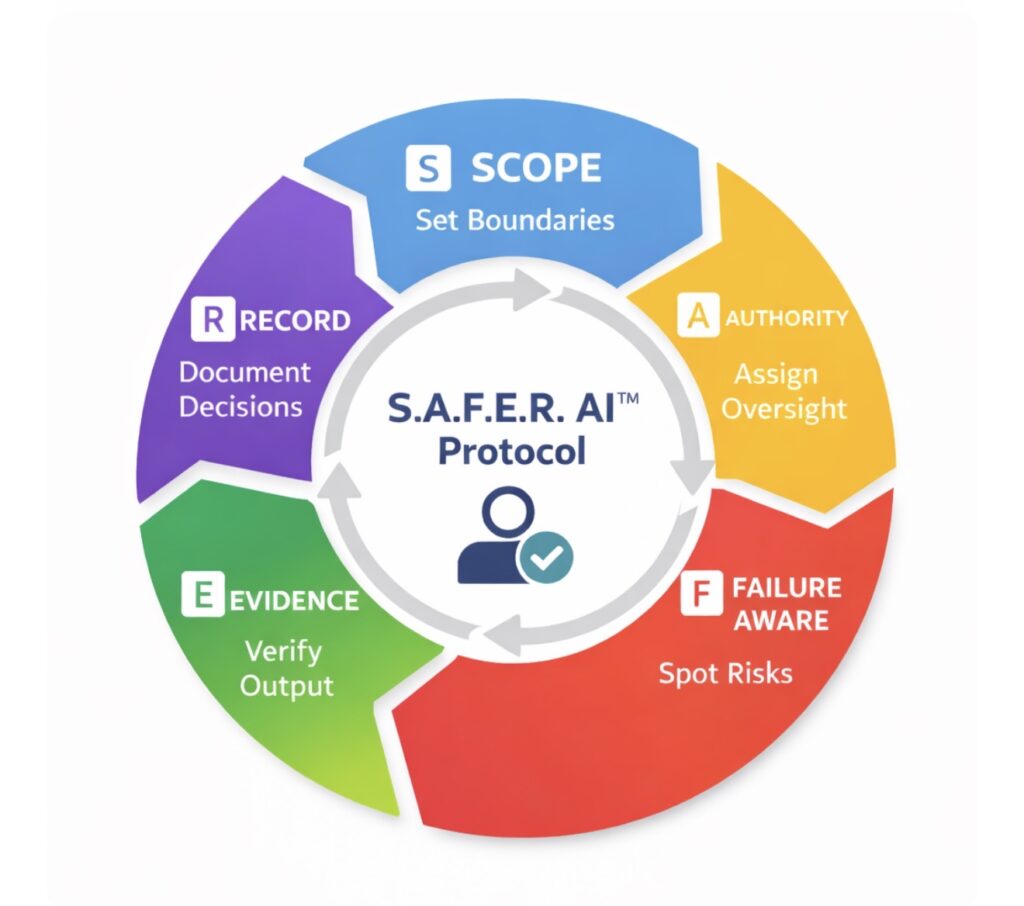
Every AI-assisted decision passes through five structured checkpoints. These checkpoints do not slow work; they make reasoning observable.
Scope: Defines whether the task itself belongs to AI at all. Before examining the output, the user determines whether the problem is appropriate for AI assistance. Some tasks tolerate approximation; others demand human origin. This step prevents misuse before evaluation even begins.
Authority: Determines who must stand behind the outcome. The person reading the output may not be the person permitted to rely on it. Responsibility is clarified before confidence is formed, preventing silent delegation of accountability to the system.
Failure Awareness: Forces consideration of how the output could be wrong. Instead of asking whether the answer looks correct, the user asks what harm would occur if it were incorrect. This shifts the mind from agreement to evaluation.
Evidence: Sets the verification depth required. Low-impact decisions may require only a brief check, while high-impact decisions require independent confirmation. Verification becomes proportional rather than arbitrary.
Record: Captures why the decision was accepted. Not the output itself, but the reasoning behind trusting it. This transforms hindsight from guessing into documentation.
The result is not extra work.
It is a structured trust.
What Changes Inside an Organization
When SAFER AI™ is applied consistently, team behavior shifts noticeably. AI usage becomes visible without becoming restricted. Managers stop asking whether employees used AI and start understanding how they evaluated it. The organization gains the ability to reconstruct decisions rather than investigate accidents.
The protocol removes three common failure patterns. Employees no longer hide usage because the process permits it. They no longer trust outputs automatically due to the assumption of sequence interrupts. They no longer avoid AI entirely because accountability remains human.
Instead of debating whether AI should be allowed, the organization understands how it is relied upon.
Decision Tiers: Matching Oversight to Consequence
Not all AI use carries equal risk. SAFER AI™, therefore, pairs the protocol with a decision classification structure. The seriousness of a mistake and the confidence in the output together determine the level of human involvement required.
Low-consequence situations allow routine verification. Increasing consequence shifts the requirement from checking to ownership. At the highest level, a human does not merely review the output; they consciously assume responsibility for the decision.
This distinction is critical.
The goal is not more checking.
The goal is clear accountability.
The Authority Structure
Many organizations struggle not because AI is inaccurate but because responsibility is ambiguous. A junior employee may rely on an output that the organization assumes a specialist reviewed. SAFER AI™ prevents this by aligning decision type with oversight level.
Routine operational use remains with the user. Elevated situations require supervisory awareness. Specialized domains require subject-matter validation. Critical outcomes require decision ownership.
AI never becomes the final authority because a human role is always explicitly attached to acceptance.
Evidence Depth
Verification should never be random. It should be scaled with impact.
A quick confirmation may be sufficient for internal drafting. Independent validation may be required for external communication. Authoritative confirmation may be required for regulated decisions. The protocol formalizes this escalation, so people do not guess how careful to be.
The same tool can therefore be used safely in both low-risk and high-risk environments because the behavior changes, not the technology.
Documentation as Protection
The final step, recording reasoning, is often misunderstood as administrative overhead. In practice, it becomes protection. When reasoning is captured, decisions remain explainable long after memory fades.
Organizations rarely face problems because they made a decision. They face problems because they cannot demonstrate how they made it. SAFER AI™ ensures they always can.
Implementation in Practice
Adoption does not require replacing existing systems. The protocol is introduced as a decision expectation rather than a technical control. Teams are trained on the sequence, oversight roles are defined, and examples relevant to the organization are documented.
Over time, the behavior becomes automatic. The pause between generation and action becomes normal. AI remains fast, but acceptance becomes deliberate.
This is the point where AI stops being experimental and becomes operational.
The Outcome
Artificial intelligence will continue to improve. The organizations that benefit most will not be those with the most powerful models, but those capable of explaining their reliance on them.
SAFER AI™ does not attempt to make machines trustworthy.
It makes humans trust a structured system.
Technology can produce answers.
Only processes can produce accountability.
In environments where decisions matter, accountability is what allows innovation to continue.